Cold Chamber & Low Temperature Chamber
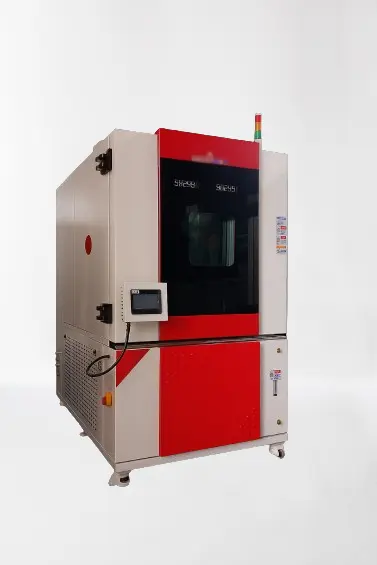
A cold chamber is a controlled-environment test enclosure built to expose products to sustained sub-zero conditions, evaluating how materials, electronics, and assemblies perform and degrade at extreme low temperatures. Also known as a low temperature chamber, it's used for cold soak testing, cold start validation, and low-temperature material property studies across automotive, aerospace, and electronics industries. Many models are configurable as a full climatic test chamber, adding humidity chamber control for combined temperature-humidity stress profiles per IEC 60068-2-1 and MIL-STD-810
What is a Cold Test Chamber?
A temperature and humidity chamber (also referred to as a humidity chamber, climate chamber, or stability chamber) is a controlled-environment test enclosure that independently regulates both temperature and relative humidity. It is used to simulate real-world environmental conditions — from cold storage to tropical heat and humidity — to evaluate how products perform and degrade over time. Temperature humidity chambers are a cornerstone of accelerated life testing (ALT) and HALT/HASS programmes. They are commonly used to meet requirements under IEC 60068-2, MIL-STD-810, JEDEC JESD22, and ICH Q1A pharmaceutical stability guidelines.
Key Specifications
- Low temperature testing for reliability validation
- Sub-zero capability (up to -70°C options)
- Stable refrigeration for repeatable performance
- Multiple chamber capacities available
- Designed for long-duration cold soak tests
Key Features
- Wide Temperature Range: -40°C to +180°C (standard), -70°C to +180°C (ultra-low option)
- Precise Humidity Control: 10% to 98% RH with ±2% RH stability
- Rapid Ramp Rates: 3–5°C/min heating, 1.5–3°C/min cooling for accelerated testing
- PLC Touchscreen Controller: Intuitive interface with programmable multi-step test profiles
- Premium Stainless Steel Construction: SS-304/316 interior for corrosion resistance
- Forced-Draft Airflow: Advanced circulation with adjustable louvers for uniform distribution
- IEC 60068 Compliant: Standards-ready with pre-loaded test protocols
- Data Logging & Analytics: Continuous recording with USB/RS-485 connectivity
- Observation Window with Interior Lighting: Monitor specimens without opening chamber
- Eco-Friendly Refrigerants: CFC-free R404A or R23 for environmental compliance
- Advanced PT-100 Sensor Arrays: Class A precision thermocouples ensure ±0.5°C stability across the entire chamber volume, meeting IEC 60068 uniformity requirements.
- CFC-Free Refrigeration: All units use eco-friendly R404A or R23 refrigerants, reducing environmental impact while maintaining -70°C to -40°C cooling performance.
- Programmable Multi-Step Profiles: PLC touchscreen controller enables complex HALT/HASS cycling with automatic ramp and soak transitions, simplifying accelerated life testing.
Cold Chamber vs. Climatic Test Chamber — Which Do You Need?
Not every low-temperature test protocol requires humidity control, and adding it when you don't need it increases both cost and maintenance complexity. Here's how to decide:
- Choose a cold chamber (temperature-only) if your test standard specifies dry cold exposure — cold start, cold soak, or low-temperature material property testing per IEC 60068-2-1 or MIL-STD-810 cold sections.
- Choose a climatic test chamber (temperature + humidity) if your protocol includes condensation, icing, freeze-thaw cycling, or combined environmental stress screening (ESS) — common in automotive electronics and aerospace certification.
- Choose a humidity chamber standalone if temperature extremes aren't required but moisture ingress, corrosion, or accelerated aging testing is the primary goal.
Unsure which your test plan calls for? Our engineering team can review your protocol and recommend the right configuration before you specify equipment.
Compliance Standards
- IEC 60068-2-1 — Cold testing
- IEC 60068-2-2 — Dry heat testing
- IEC 60068-2-78 — Damp heat (steady state)
- IEC 60068-2-30 — Damp heat (cyclic)
- MIL-STD-810 — Methods 501, 502, 507 (environmental testing)
- JEDEC JESD22-A101 — Steady state humidity bias testing
- ICH Q1A — Pharmaceutical stability testing guidelines
- ASTM D4169 — Packaging during storage and transport
- ISO 2533 — Standard atmosphere specifications
Applications
- Automotive: Dashboard, wiring harness, lighting system durability under extreme climates
- Aerospace & Defense: Component qualification, altitude/thermal cycling for flight systems
- Electronics & Semiconductors: PCB reliability, IC packaging validation, thermal cycling
- Pharmaceuticals: Stability testing per ICH Q1A for shelf-life determination
- Renewable Energy: Solar panel efficiency, battery thermal performance, wind turbine materials
- Materials Science: Polymer aging, adhesive bond strength, corrosion resistance
- Telecommunications: Equipment reliability in extreme climate zones
- Food & Beverage: Shelf-life simulation, packaging material degradation
Safety Features
- Over-temperature / under-temperature safety protection
- Compressor protection and overload safety controls
- Alarm indications for safe monitoring and operation
Optional Features
- Data logging and test report export
- Remote monitoring and alarm outputs
- Custom cable ports and sample fixtures
- Special low-temperature insulation enhancements (as required)
How It Works
- Load samples into the chamber with proper spacing
- Set low temperature setpoint or profile on the controller
- Chamber stabilises and maintains sub-zero conditions
- Run cold soak exposure for required duration
- Record performance data for validation and reporting
Datasheets & Resources
- Temperature Range
Frequently Asked Questions about Cold test chamber
What is a cold test chamber used for?
Cold test chambers are used to evaluate product performance at low temperatures through cold soak and reliability exposure testing.
How low can the temperature go?
Indeecon cold test chambers can be configured for sub-zero ranges up to -70°C depending on capacity and test requirements.
Can the chamber run long-duration cold soak tests?
Yes. The chamber is designed for stable long-duration cold exposure testing with reliable refrigeration performance.
Is it suitable for automotive and electronics testing?
Yes. It is widely used for automotive, EV, electronics, battery and material cold performance validation.
Can you add data logging and monitoring?
Yes. Data logging, alarm outputs and remote monitoring options can be integrated based on your workflow.
Do you provide installation and AMC support?
Yes. Indeecon provides commissioning support and optional AMC/service plans for long-term uptime.
What's the difference between a cold chamber and a climatic test chamber?
A cold chamber is purpose-built for sub-zero, temperature-only testing, while a climatic test chamber (or humidity chamber) adds independent humidity control alongside temperature — useful when a test protocol requires combined cold testing and moisture exposure in a single cycle.
Can this cold chamber be configured with humidity control?
Yes, select models can be configured as a climatic test chamber with humidity chamber capability. Speak with our engineering team to confirm humidity range requirements for your test protocol.
What temperature range defines a low temperature chamber?
A low temperature chamber typically operates from ambient down to -70°C, with some cryogenic-capable models reaching lower. The exact range depends on the compressor stage (single vs. cascade refrigeration) and insulation design — check the model's spec sheet for the guaranteed lower setpoint.
How long does cold testing typically take?
Cold testing duration depends on the standard being followed and the test article's thermal mass. A single cold soak cycle per IEC 60068-2-1 can range from 2 to 96 hours at setpoint, while cold start or repeated cycling protocols run longer. Smaller components stabilize faster than large assemblies.
Does a cold chamber require humidity control for automotive testing?
Not always. Standard automotive cold soak and cold start testing typically needs temperature control only. Humidity chamber capability becomes necessary when the test protocol calls for combined cold-and-condensation exposure, such as freeze-thaw or icing simulation.
Can a cold chamber be upgraded to a climatic test chamber later?
Some chamber platforms support humidity module retrofits, but it depends on the base unit's design — insulation, door seals, and control system all need to support humidity generation. It's more cost-effective to specify humidity chamber capability at time of purchase if there's any chance you'll need it.
Related Guides
Continue your evaluation with the most relevant master pages, comparison guides, and technical resources for this product family.
- Environmental Test Chamber Guide — Overview of chamber types, standards, and use-case fit.
- Environmental Chamber Selection Guide — Choose the right chamber by range, specimen size, and standard.