Cyclic Corrosion Chamber
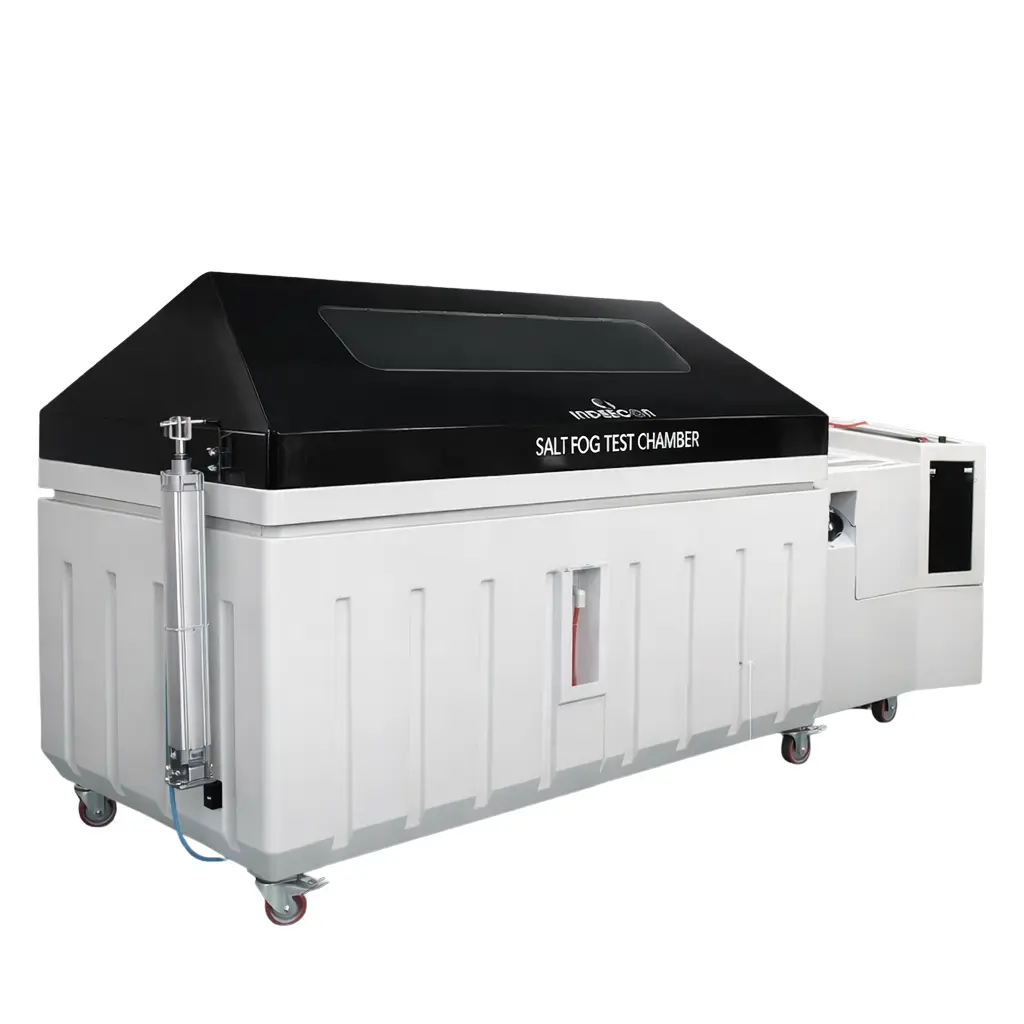
Cyclic Corrosion Chamber Combined salt spray, humidity and drying cycles. Fully automated transition between test phases. Ideal for Automotive.
A cyclic corrosion chamber simulates real-world corrosion environments by automating multi-phase cycles including salt fog exposure, humidity soaks, and forced dry-off phases. These systems test component durability against accelerated corrosion following VDA 233-102, GMW14872, and ASTM G85 standards—critical for automotive and aerospace applications.
Key Specifications
- Combined salt spray, humidity and drying cycles
- Fully automated transition between test phases
- Adjustable salt fog atomization for uniformity
- Touchscreen PLC with multi-step test programming
- Corrosion-resistant FRP/PP internal construction
Key Features
- Automated multi-phase cycle programming with pre-loaded OEM profiles (VDA, SAE, GMW, Volvo)
- Precision climate control: Temperature ±0.5°C, Humidity 20-98% RH with advanced psychrometric control
- High-velocity heated air drying system for uniform 'Dry-Off' phases
- Rotating specimen carousel eliminating shadowing effects for consistent exposure
- pH monitoring and automated salt concentration adjustments
- Heavy-duty Polypropylene (PP) or Glass-Reinforced Plastic (GRP) construction with high-grade silicone gaskets
- Non-clogging precision quartz/acrylic atomization nozzles
- Typical Cycle Profile (VDA 233-102)
- Temperature Range: Ambient to +70°C (±0.5°C precision)
- Humidity Control: 20% to 98% RH with advanced psychrometric control for VDA compliance
- Air Drying System: High-velocity heated air blower ensuring rapid, uniform drying without thermal stress
- Automated Solution Management: Real-time pH monitoring with automatic salt concentration adjustments maintain test integrity throughout extended cycles.
- Specimen Carousel: Rotating carousel provides uniform exposure geometry, eliminating shadowing effects that compromise test validity.
- Complex Profile Programming: Pre-programmed OEM profiles (VDA, SAE, GMW) with custom ramp/soak capability for flexible test requirements.
- Precision Engineering: ±0.5°C temperature stability meets strictest OEM requirements
- Automated Expertise: Pre-loaded VDA, SAE, GMW profiles eliminate setup complexity
- Global Compliance: Systems certified for all major automotive/aerospace standards
- Custom Solutions: Chamber sizes from 450L to walk-in configurations (2000L+)
- Ongoing Support: Technical consultation, profile validation, maintenance programs
Compliance Standards
- VDA 233-102 (Volkswagen Group – Cyclic Corrosion)
- GMW14872 (General Motors Worldwide – Salt Fog Humidity Cycle)
- SAE J2334 (SAE – Cyclic Corrosion Testing)
- ASTM G85 (American Standard for Corrosion Testing)
- Volvo STD 423-0014 (Volvo Group Corrosion Testing)
- ISO 12944 (Paints and Coatings – Corrosion Protection)
Applications
- Automotive & Transportation: Corrosion testing of vehicle components, fasteners, body panels, and coatings
- Aerospace & Defence: Qualifying surface treatments and protective finishes per military specifications
- Electronics & Electrical: Testing PCBs, connectors, terminals, and housings for corrosion susceptibility
- Industrial Hardware: Evaluating bolts, nuts, springs, chains, and structural steel components
- Coatings & Surface Finishing: Validating paint systems, anodising, electroplating, and powder coatings
Safety Features
- Over-temperature safety cutout for heater tanks
- Low-level salt solution alarm and auto-stop
- Phase failure and blower motor protection
- Exhaust air filtration/scrubbing interface
Optional Features
- SO2 gas injection for Kesternich testing
- Refrigeration unit for sub-ambient cooling cycles
- Automated salt solution mixing and storage tank
- Data logging with Ethernet/Smart Connectivity
How It Works
- Place samples in the chamber at specified angles (e.g., 15-20°)
- Program the sequence of salt spray, humidity and drying steps
- The PLC automates the shift between heaters, blowers and atomizers
- Monitor the solution consumption and chamber environment
- Evaluate the degree of corrosion or coating failure after the cycle
Datasheets & Resources
- Temp Range (Salt Spray)
- Temp Range (Drying)
- Humidity Range
Frequently Asked Questions
What is the benefit of CCT over standard salt spray?
CCT better mimics real-world conditions by alternating wet and dry states, which is often more aggressive than constant salt fog.
Can it run standard ASTM B117 salt spray tests?
Yes. All our CCT chambers can perform standard continuous salt spray tests as well.
What material is used for the chamber body?
We use high-grade FRP (Fibre Reinforced Plastic) or Polypropylene to ensure maximum life against corrosive solutions.
Does it require compressed air?
Yes. High-quality dry compressed air is required for salt fog atomization and drying cycles.
Do you offer scrubbers for the exhaust?
Yes. We can provide optional chemical scrubbers to neutralise the exhaust before it is vented to the atmosphere.
Related Guides
Continue your evaluation with the most relevant master pages, comparison guides, and technical resources for this product family.
- Environmental Test Chamber Guide — Overview of chamber types, standards, and use-case fit.
- Environmental Chamber Selection Guide — Choose the right chamber by range, specimen size, and standard.
- Salt Spray Chamber Guide — Chamber types, test methods (NSS/CASS/AASS), and standards for corrosion qualification.
- ASTM B117 Technical Guide — Testing procedure, setup requirements, and compliance basics.