Hot/Cold Humidity Chamber
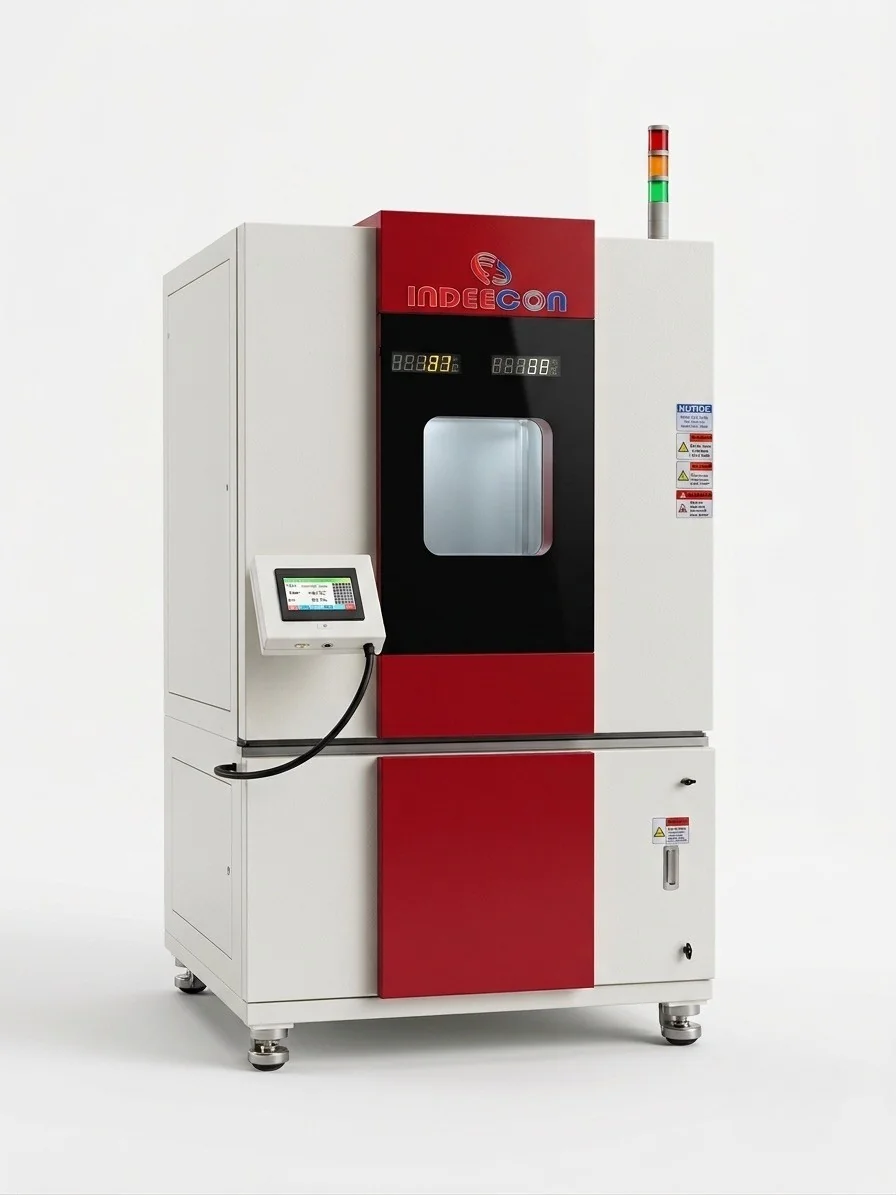
Hot/Cold Humidity Chamber -70°C to +180°C. Humidity control: 20% to 95% RH. Ideal for Automotive. IEC 60068-2-1 compliant. Get a quote.
A temperature and humidity chamber (also referred to as a humidity chamber, climate chamber, or stability chamber) is a controlled-environment test enclosure that independently regulates both temperature and relative humidity. It is used to simulate real-world environmental conditions — from cold storage to tropical heat and humidity — to evaluate how products perform and degrade over time. Temperature humidity chambers are a cornerstone of accelerated life testing (ALT) and HALT/HASS programmes. They are commonly used to meet requirements under IEC 60068-2, MIL-STD-810, JEDEC JESD22, and ICH Q1A pharmaceutical stability guidelines.
Key Specifications
- Temperature range: -70°C to +180°C
- Humidity control: 20% to 95% RH
- Advanced humidification for stable TH environment
- PLC-based touchscreen controller with graphing
- Designed for ICH stability and reliability testing
Key Features
- Wide Temperature Range: -40°C to +180°C (standard), -70°C to +180°C (ultra-low option)
- Precise Humidity Control: 10% to 98% RH with ±2% RH stability
- Rapid Ramp Rates: 3–5°C/min heating, 1.5–3°C/min cooling for accelerated testing
- PLC Touchscreen Controller: Intuitive interface with programmable multi-step test profiles
- Premium Stainless Steel Construction: SS-304/316 interior for corrosion resistance
- Forced-Draft Airflow: Advanced circulation with adjustable louvers for uniform distribution
- IEC 60068 Compliant: Standards-ready with pre-loaded test protocols
- Data Logging & Analytics: Continuous recording with USB/RS-485 connectivity
- Observation Window with Interior Lighting: Monitor specimens without opening chamber
- Eco-Friendly Refrigerants: CFC-free R404A or R23 for environmental compliance
- Advanced PT-100 Sensor Arrays: Class A precision thermocouples ensure ±0.5°C stability across the entire chamber volume, meeting IEC 60068 uniformity requirements.
- CFC-Free Refrigeration: All units use eco-friendly R404A or R23 refrigerants, reducing environmental impact while maintaining -70°C to -40°C cooling performance.
- Programmable Multi-Step Profiles: PLC touchscreen controller enables complex HALT/HASS cycling with automatic ramp and soak transitions, simplifying accelerated life testing.
Compliance Standards
- IEC 60068-2-1 — Cold testing
- IEC 60068-2-2 — Dry heat testing
- IEC 60068-2-78 — Damp heat (steady state)
- IEC 60068-2-30 — Damp heat (cyclic)
- MIL-STD-810 — Methods 501, 502, 507 (environmental testing)
- JEDEC JESD22-A101 — Steady state humidity bias testing
- ICH Q1A — Pharmaceutical stability testing guidelines
- ASTM D4169 — Packaging during storage and transport
- ISO 2533 — Standard atmosphere specifications
Applications
- Automotive: Dashboard, wiring harness, lighting system durability under extreme climates
- Aerospace & Defense: Component qualification, altitude/thermal cycling for flight systems
- Electronics & Semiconductors: PCB reliability, IC packaging validation, thermal cycling
- Pharmaceuticals: Stability testing per ICH Q1A for shelf-life determination
- Renewable Energy: Solar panel efficiency, battery thermal performance, wind turbine materials
- Materials Science: Polymer aging, adhesive bond strength, corrosion resistance
- Telecommunications: Equipment reliability in extreme climate zones
- Food & Beverage: Shelf-life simulation, packaging material degradation
Safety Features
- Over-temperature and low-water level alarms
- Compressor safety cutouts and pressure switches
- Dry-run protection for steam generators
- Electrical surge and phase failure protection
Optional Features
- Data logging and 21 CFR Part 11 compliant software
- Oxygen/CO2 concentration monitoring (optional)
- Customised shelving and interior configurations
- Built-in water deionizer for humidification tank
How It Works
- Select the desired temperature and humidity setpoints
- The system activates heating/cooling and humidification/dehumidification
- Air is circulated through the plenum to ensure uniform conditions
- Sensors provide real-time feedback to the PID controller
- Monitored data can be logged or exported for compliance
Datasheets & Resources
- Temperature Range
- Humidity Range
- Stability
- Power Supply
Frequently Asked Questions
What is the typical humidity stability?
Our chambers maintain a high level of stability, typically within ±2% RH to ±3% RH during steady-state conditions.
Can I use the chamber for ICH stability studies?
Yes. Our humidity chambers are widely used for pharmaceutical stability testing according to ICH guidelines.
Does it require a continuous water supply?
A demineralized water supply is recommended. Most models include an internal tank or can be connected to an external source.
What is the largest chamber volume available?
We provide standard volumes up to 2000L and offer walk-in climatic rooms for larger requirements.
Do you provide DQ/IQ/OQ/PQ documentation?
Yes. We offer comprehensive validation documentation packages for laboratory and pharmaceutical customers.
What is a temperature and humidity chamber used for?
A temperature and humidity chamber simulates real-world environmental conditions — from freezing cold storage to tropical heat and high humidity — to test how products perform and degrade over time. It is widely used for accelerated life testing, pharma stability studies, automotive component validation, and electronics reliability testing.
What is the difference between a hot chamber and a cold chamber?
A hot chamber tests products under elevated temperatures to evaluate heat resistance, material degradation, and performance at high thermal stress. A cold chamber tests under sub-zero conditions to assess low-temperature performance, brittleness, and cold-start reliability. A temperature and humidity chamber combines both hot and cold testing in a single unit with added humidity control.
What temperature range does Indeecon's temperature and humidity chamber cover?
Indeecon's standard temperature and humidity chamber covers -40°C to +180°C. The ultra-low option extends this to -70°C to +180°C, making it suitable for cold chamber applications in aerospace, EV battery testing, and pharmaceutical cold-chain validation.
Can this chamber be used as a cold chamber for EV battery testing?
Yes. The ultra-low temperature option (-70°C to +180°C) makes it suitable for EV battery thermal performance testing, cold-start simulation, and thermal cycling as per IEC 60068 and MIL-STD-810 standards. The chamber can also be configured as a dedicated cold chamber for specific low-temperature applications.
Can the hot chamber function be used independently without humidity control?
Yes. Indeecon's temperature and humidity chamber can operate in dry heat mode as a standalone hot chamber — without activating the humidity system. This is useful for dry heat testing per IEC 60068-2-2 and thermal ageing studies where humidity is not a test variable.
What is the difference between a temperature and humidity chamber and a thermal shock chamber?
A temperature and humidity chamber gradually ramps between hot and cold conditions while controlling humidity — ideal for long-term ageing and stability studies. A thermal shock chamber rapidly transfers products between extreme temperature zones in under 30 seconds — designed for mechanical stress and material failure testing. Both serve different testing standards and use cases.
Related Guides
Continue your evaluation with the most relevant master pages, comparison guides, and technical resources for this product family.
- Environmental Test Chamber Guide — Overview of chamber types, standards, and use-case fit.
- Environmental Chamber Selection Guide — Choose the right chamber by range, specimen size, and standard.