Walk-in Stability Chamber (ICH)
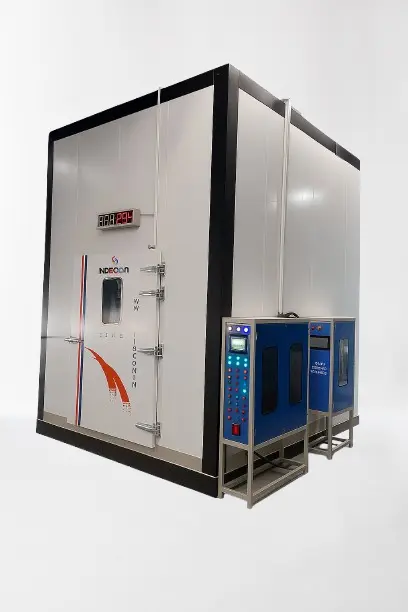
Walk-in Stability Chamber (ICH) ICH Q1A stability guidelines. Precise temperature and humidity control. Ideal for Automotive components. SAE J2030 compliant.
A walk-in chamber is an insulated environmental enclosure large enough for personnel and equipment access, enabling real-time testing of full systems—vehicles, powertrains, battery modules—under controlled temperature and humidity. Unlike benchtop chambers, walk-ins offer modular construction for rapid deployment, heavy-duty floors for vehicle loading, and scalable volume from 2 m³ (compact labs) to 100+ m³ (contract testing hubs). Advanced models support thermal ramp rates up to 5°C/min, critical for automotive qualification and aerospace durability validation.
Key Specifications
- Complies with ICH Q1A (R2) stability guidelines
- Precise temperature (±0.5°C) and humidity (±2% RH) control
- Redundant cooling and humidity systems for 24/7 reliability
- 21 CFR Part 11 compliant data management and audit trails
- Modular design for high capacity pharmaceutical storage
Key Features
- Modular Cam-Lock PUF Construction: Tongue-and-groove panels with thermal-bridge-free assembly — on-site build-up in 2–5 days, no permanent installation required
- Heavy-Duty Floor Reinforcement: Stainless steel 304 checkered plates support full vehicles (up to 3,000 kg/m²) and EV battery packs without floor deflection
- 100+ Air Exchanges per Hour: Turbo-blower with mist elimination maintains ±1°C uniformity across chambers up to 100+ m³ — prevents stratification in large volumes
- Advanced Humidity Control: 10–95% RH standard (5–98% RH in performance models) with dew-point sensing and dual-compressor design for rapid ramp cycles
- Fast-Ramp Option: Up to 5°C/min thermal transitions — welded high-temp steel construction for ALT and thermal shock protocols
- Personnel Safety System: Interior door release mechanism, emergency audible alarm, and main kill switch — disables all heating/cooling for immediate safe exit
- Temperature Range: Standard S-Series -40°C to +85°C; Drive-In L-Series -20°C to +85°C; Fast-Ramp -70°C to +150°C
- Optional: Multi-zone sensor arrays, cloud data logging with real-time alerts, IoT compliance reporting
Compliance Standards
- SAE J2030 — Environmental Limits and Testing Requirements for Electronic Equipment in Heavy-Duty Vehicles
- ASTM E691 — Round-Robin Testing for Environmental Chambers; precision and bias assessment
- MIL-STD-810H — DoD Environmental Engineering Test Method Standard
- ISO 17025 / NABL — Chamber uniformity mapping, temperature/humidity calibration, and traceability documentation
Applications
- Automotive Components & Full Vehicle Testing: Door seals, HVAC, ECMs, infotainment systems, and full vehicle validation per OEM protocols
- EV Battery Testing: BMS qualification, high-voltage harness testing, module-level thermal cycling for cell safety validation
- Aerospace Large Assemblies: Flight control surfaces, avionics racks, and structural panels under combined thermal and humidity stress
- Electronics & Power Distribution: Industrial inverters, power supplies, and converter reliability under combined temperature and humidity stress
- Contract Testing Laboratories: High-throughput multi-client capability with certified uniformity, SPC data logging, and audit trail documentation
- R&D Prototype Durability: Accelerated life testing (ALT) and failure mode analysis for automotive and aerospace components
Safety Features
- Multi-point over-temperature and over-humidity alarms
- Personnel emergency alarm and internal release lock
- Automated system switchover for redundant components
- Mains failure and data loss protection with battery backup
Optional Features
- Complete validation package (IQ, OQ, PQ documentation)
- Web-based remote monitoring and SMS alert systems
- Multi-channel data scanner with 21 CFR compliance
- Full stand-by refrigeration and humidity units
How It Works
- Samples are loaded into the modular stability room shelves
- Environmental setpoints (e.g., 25°C/60%RH) are configured on the HMI
- The system maintains extremely stable conditions for the test duration
- Redundant systems monitor performance and take over if necessary
- Data is continuously logged for audit reporting and compliance
Datasheets & Resources
- Temp Settings
- Humidity Settings
- Data Management
Frequently Asked Questions
Q: What is the difference between Standard and Large/Drive-In series?
A: Standard (S-Series, 2–12 m³) accommodates benchtop equipment and small assemblies with personnel access via door. Large (L-Series, 20–100+ m³) features drive-in access and reinforced floor (3,000 kg/m²) for full-vehicle and engine testing.
Q: How accurate is the ±1°C uniformity specification?
A: Uniformity is measured per ASTM E691 across 9–16 sensor points distributed throughout the chamber at mid-cycle. Achieved via 100+ air exchanges/hour and optimized return-air ducting.
Q: Can you retrofit an existing chamber for higher ramp rates?
A: Partial retrofits (improved AHU, control upgrade) are possible but limited by chamber mass and compressor capacity. For 5°C/min ramps, a new welded Fast-Ramp design is recommended.
Q: Do you provide ISO 17025 calibration certificates?
A: Yes. Our NABL-accredited lab offers annual chamber uniformity mapping, control sensor calibration, and traceability documentation as part of the comprehensive service plan.
Q: What is the typical energy consumption for a 50 m³ chamber?
A: 15–25 kW (heating) + 8–12 kW (cooling compressors + AHU) depending on thermal load and ramp rate. We provide detailed power budgets during design phase.
Plan Your Walk-In Chamber Installation
Our thermal engineering team conducts site surveys, designs custom chamber layouts, and provides turnkey installation with NABL calibration. Contact us for a feasibility assessment.
Related Guides
Continue your evaluation with the most relevant master pages, comparison guides, and technical resources for this product family.
- Environmental Test Chamber Guide — Overview of chamber types, standards, and use-case fit.
- Environmental Chamber Selection Guide — Choose the right chamber by range, specimen size, and standard.
- XLPE Curing Automation Guide — Process-engineering guide for curing automation and throughput planning.