Thermal Shock Chamber for EV Battery Testing
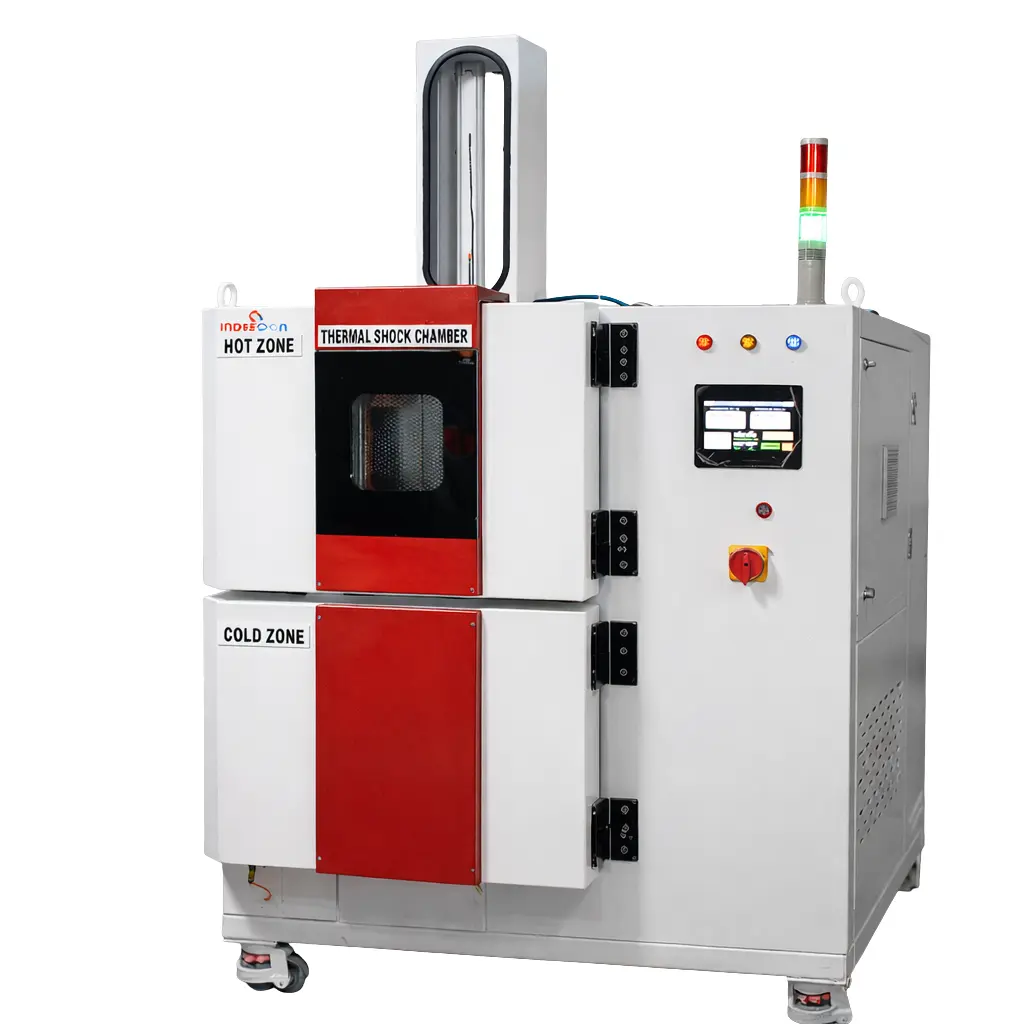
Indeecon's thermal shock chambers deliver ultra-rapid temperature transitions with sub-10 second transfer time for accelerated thermal shock testing and EV battery testing. Systems span 30L to 1000L+ with temperatures from -70°C to +200°C and recovery times as fast as 5 minutes. Built to MIL-STD-810H, IEC 60068-2-14, and AEC-Q100 automotive standards, with integrated fire suppression, H₂/CO gas sensors, and anti-condensation logic for safe lithium-ion battery testing.
What is a Thermal Shock Chamber?
A thermal shock chamber rapidly cycles test specimens between extreme hot and cold zones, simulating temperature stress that products experience in real-world operations. Thermal shock testing is critical for detecting design weaknesses in solder joints, battery connections, seal materials, and structural integrity. Essential applications include:
What Makes Our Thermal Shock Chamber Stand Out
- Temperature range: -70°C to 200°C (model dependent)
- Basket transfer time: <10 seconds
- Capacity options: 50L to 1000L
- Two-zone / Three-zone configurations available
- PLC / controller based automation with safety interlocks
Key Features
- Sub-10-Second Basket Transfer: Pneumatic or servo-driven mechanism with soft-start/soft-stop reduces cycle time and prevents vibration interference — critical for sensitive battery testing
- Oversized Pre-Heat/Pre-Cool Zones: Thermal reservoirs enable full temperature stabilisation within 5–15 minutes per cycle — benchtop systems recover in as fast as 5 minutes
- Multi-Level EV Battery Safety: Integrated fire suppression, H₂/CO gas sensors, pressure relief vents, and thermal runaway containment protect test staff and equipment
- Anti-Condensation Purge Logic: Automated dry-air injection during cold-to-hot transitions prevents condensation-induced false electrical shorts — critical for EV battery validation
- High-Speed NABL Data Logging: 1-second sampling intervals capture temperature, humidity, pressure, and gas sensor readings with time-stamped validation for regulatory compliance
- Three Size Categories: Benchtop (30–60L) for cell testing, mid-range (150–300L) for modules, large-scale (500–1000L+) for full EV battery pack testing
- Temperature Range: -70°C to +200°C (cold zone -10°C to -70°C; hot zone +60°C to +200°C depending on size)
- Transfer Times: Under 10 seconds (benchtop/mid-range), under 15 seconds (large/pack-level systems)
The Thermal Shock Test Method
The thermal shock test method follows a repeatable cycle: specimens are loaded into a transfer basket, exposed to an extreme hot or cold setpoint, held for a defined dwell time to reach thermal equilibrium, then rapidly transferred to the opposite temperature zone — all within seconds, not minutes. This rapid transition is what distinguishes true thermal shock testing from standard ramped thermal cycling.
A typical thermal shock test method includes:
- Pre-conditioning — specimen stabilization at ambient temperature
- Hot soak — dwell at maximum temperature setpoint per test standard
- Rapid transfer — basket movement to cold zone in under 10 seconds
- Cold soak — dwell at minimum temperature setpoint
- Cycle repetition — process repeats for the specified number of cycles
- Data logging — temperature, humidity, and gas sensor readings recorded throughout for compliance reporting
This method is defined under MIL-STD-810H (Method 503.6) and IEC 60068-2-14, and is the primary validation approach for EV battery testing, automotive electronics, and aerospace component qualification.
Compliance Standards
- MIL-STD-810H (Method 503.6) — Thermal Shock Testing; temperature transition rates and recovery time validation
- IEC 60068-2-14 — Environmental testing for electrical/electronic items; thermal cycle procedures and acceptance criteria
- AEC-Q100 — Automotive Electronics Reliability qualification; critical for EV battery and semiconductor certification
- NABL-Compliant Data Logging — 1-second sampling with thermal profiling for regulatory submission
Industries That Rely on Our Thermal Shock Chamber
- EV Battery Testing: Module and pack-level thermal cycling for reliability validation in battery development and certification
- Automotive Electronics: Connector, seal, and ECM durability under extreme temperature swings per AEC-Q100
- Aerospace & Defense: High-reliability component qualification per MIL-STD-810H
- Semiconductor & Microelectronics: Solder joint fatigue analysis and package integrity testing
- Materials Research: Thermal expansion coefficient measurement, fatigue analysis, and material property studies
- Quality Assurance: Production thermal shock validation for product certification and outgoing QC
Safety Features
- High / Low temperature protection with alarms
- Overload protection for heaters and motors
- Emergency stop and door safety interlock
Optional Features
- Custom basket sizes and payload configurations
- Data logging and report generation
- Remote monitoring / Ethernet communication
- Low temperature enhancement package (as per application)
How It Works
- Samples are loaded into the basket and the test profile is selected
- Basket transfers between hot and cold zones as per programmed cycle
- Dwell time ensures proper thermal soak at each setpoint
- Repeated cycling simulates real-world thermal stress conditions
- System logs test parameters for traceability and validation support
Datasheets & Resources
- Temperature Range
- Transfer Time
- Chamber Capacity
- Zones
- Power Supply
- Phase
Frequently Asked Questions about Thermal Shock Chamber
What is the typical cycle time for thermal shock testing?
A single cycle (transfer + dwell + recovery) typically takes 20–40 minutes depending on chamber size and temperature range. Benchtop systems recover fastest at ~5 minutes per cycle.
How do you prevent condensation during cold-to-hot transitions?
Automated dry-air purge logic injects compressed, desiccant-dried air into the test zone during warm-up phases, evaporating moisture before electrical connections are energized.
Can these chambers test lithium-ion battery packs safely?
Yes. Our large-scale systems include fire suppression, H₂/CO gas sensors, thermal runaway containment vents, and emergency shutoff—certified for safe EV battery testing.
What data logging is available?
NABL-compliant high-speed data logging at 1-second intervals captures temperature, humidity, pressure, and gas sensor readings with time-stamped validation for regulatory compliance.
What is the standard thermal shock test method?
The standard thermal shock test method involves transferring specimens between a hot zone and cold zone within a strict time limit (typically under 10 seconds) using a basket-transfer mechanism, followed by a dwell period at each temperature extreme. This cycle repeats for a set number of cycles per MIL-STD-810H (Method 503.6) or IEC 60068-2-14, simulating years of thermal stress in a compressed test window.
What's the difference between thermal shock testing and thermal cycling?
Thermal shock testing uses two separate chambers (hot and cold zones) with a rapid mechanical transfer between them, achieving temperature change rates far faster than a single-chamber thermal cycling system. This makes thermal shock chambers better suited for detecting sudden-stress failures like solder cracking or seal fatigue, while thermal cycling chambers are typically used for slower, ramped-rate testing.
How many cycles are required for EV battery thermal shock testing?
Cycle counts vary by standard and application, but EV battery testing commonly ranges from 5–100+ cycles depending on the qualification protocol (e.g., AEC-Q100 or internal OEM specifications). Indeecon's chambers support fully programmable cycle counts, dwell times, and transfer profiles to match your specific test plan.
What sample sizes can be tested in a thermal shock chamber?
Sample sizes range from individual battery cells in benchtop units (30–60L) to full EV battery packs in large-scale systems (500–1000L+). Basket configurations can be customized to match your specimen dimensions and payload weight.
Is thermal shock testing required for EV battery certification?
Yes. Thermal shock testing is a mandatory validation step under most automotive and battery certification frameworks, including AEC-Q100 and IEC 60068-2-14, as it verifies that battery packs, modules, and cells can withstand rapid temperature swings without connection failure, seal degradation, or thermal runaway risk.
Related Guides
Continue your evaluation with the most relevant master pages, comparison guides, and technical resources for this product family.
- Environmental Test Chamber Guide — Overview of chamber types, standards, and use-case fit.
- Environmental Chamber Selection Guide — Choose the right chamber by range, specimen size, and standard.